
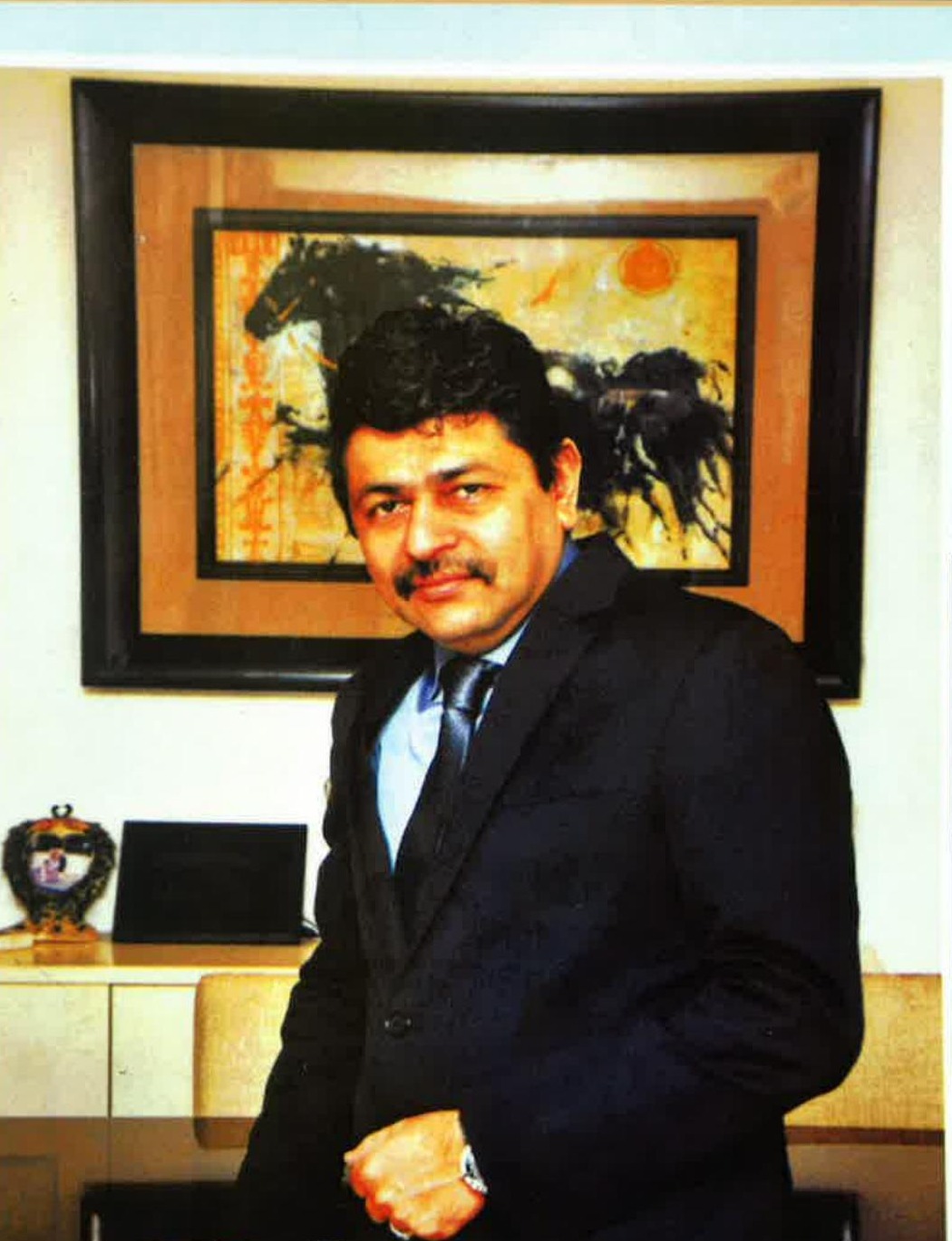
“Rejesh Satiija started his business life as a Government supplier that was not, as he says, ‘his cup of tea.’ He made use of every opportunity thereafter that came his way, making a success of it.”— Nelofer Tekchand, Editor, NRI Achievers
An extraordinary person, an extraordinary life, and extraordinary luck — is the thought that strikes me on getting to know Rejesh Satiija's life story. Born to simple, principled God-fearing parents working for the Government of India, he grew up in an uncomplicated home devoid of luxuries. The lack of luxury was made up for by the ample "sanskars" and the family's abiding faith in God. Schooling and college followed in Sonepat, Haryana; armed with a degree in Electronic Engineering from the Government College, he stepped out to make a career and ended up as a Government supplier.
This was not to his liking, and in the search for an alternative, he travelled to Africa. Import and export was a big and reputed business in those times. He was keen to check out the ground realities operative in Africa for himself, and very soon he was trading various goods and commodities there. "God was with me…" he says, very humbly, "and my meditation, unshakeable commitment to sanskar and the values instilled by my parents — all bore fruit. Even I cannot believe where my life has reached today."
Sun & Sand Industries Limited was set up in 2001 with a world-class facility covering 52 acres at Ogun, Nigeria, producing ferrous and non-ferrous ingots. These ingots, made of different alloys, are used by the best of automobile companies for making components — Toyota Tsusho Corporation Japan was Rejesh's first client for the ingots, and soon he had orders from Rolls Royce, Honda and Nissan. With Toyota going on to be an anchor client, his product list continued to expand, and soon his companies had some of the most renowned names of automobile manufacturers on their books.
The products from his company, used by various prestigious organisations worldwide, are aluminium, copper, lead, stainless steel and tin ingots and alloys, with a capacity of 30,000 to 150,000 metric tons. Strict quality control complies with internationally recognised standards and functions independently of the management. He says: "Any organisation needs to grow and sustain itself — that can happen only if it follows employee-friendly policies. All my organisations enjoy high loyalty because we ensure that each individual gets an opportunity to develop and grow within an environment of belonging. With the emotional, mental and physical health of the employees being an important aspect that contributes to a positive atmosphere, we have provided recreational facilities to keep monotony out of the work place, besides conducting training programs to help enhance skills."
“Try not to become a man of success but rather to become a man of values.”— Albert Einstein, quoted by Rejesh Satiija
No one from his family had any experience of business
He was the very first person to enter the business world. His experience as a government supplier, rather his dislike of being in the government supplies business, led him to explore other avenues, ending in Africa. Starting with Africa-based import and export, going on to setting up a factory and trying to supply Toyota with basic material to manufacture automobile parts, he is today set to supply multinational companies manufacturing automobile parts worldwide. His group reputed in the field of mining in Africa for tin, gold, copper and other precious metals. He says that it is sheer luck and his firm faith in spirituality that despite a humble beginning, his group is today ready for listing on the London Stock Exchange and as well as The London Metal Exchange. "Despite the success achieved, home always beckons, and so it was with Rejesh." After going on from strength to strength in Africa, he turned his freshly honed business acumen to India: Real Estate, mining, and manufacturing are some of the fresh ventures being flagged off.
He himself is surprised by all that is happening. He has no airs or pretense about how he has reached where he has, and it is this refreshing unique quality that makes him so down to earth and an endearingly straightforward person. "It is not as if I have never made a wrong decision — I have. But then I have totally surrendered to God, so I don't think endlessly about it, and I find that everything works itself out to a fitting solution."
As an example, he tells of an incident that occurred during his early days in Nigeria. To conduct any kind of commercial activity, a local partner holding 51% of the stake is a legal requirement. With this in mind, he invited a lady to be a stakeholder in the Nigeria operations. "But it did not work out, and he had to go through a great deal of angst due to the negative vibrations from her. Unable to do a thing about it, he put it out of his thoughts and left it to God. Then, one day, he came back from a trip and found the resignation letter of the person who had become a thorn in his flesh. Just like that, without any indication to him, the lady was out of the venture." "There are many other people who enjoy greater wealth and power as compared to me, but in one respect I am very fortunate: what I think, becomes. Many times I have wanted to achieve or perform an activity in a certain way, but in execution, the result is contrary, and I realise that it was due to an incorrect decision. However, in the long run, everything works out satisfactorily, and that wrong decision ends up being the correct decision. Another incident he reminisces about is the first trip he made to London. Going around, he liked the Mayfair area very much, and thought to himself, if ever I have a house in London, it will be in this area only. Sometime later a gentleman came to him and mentioned that he was toying with the idea of selling his flat in Mayfair — not being one to let this opportunity slip by, Rejesh bought the flat from him. During negotiations, his attention was drawn to the fact that the ex-owner of the Mayfair flat drove a Rolls Royce, and so it was a Rolls Royce for Rejesh the very next day."
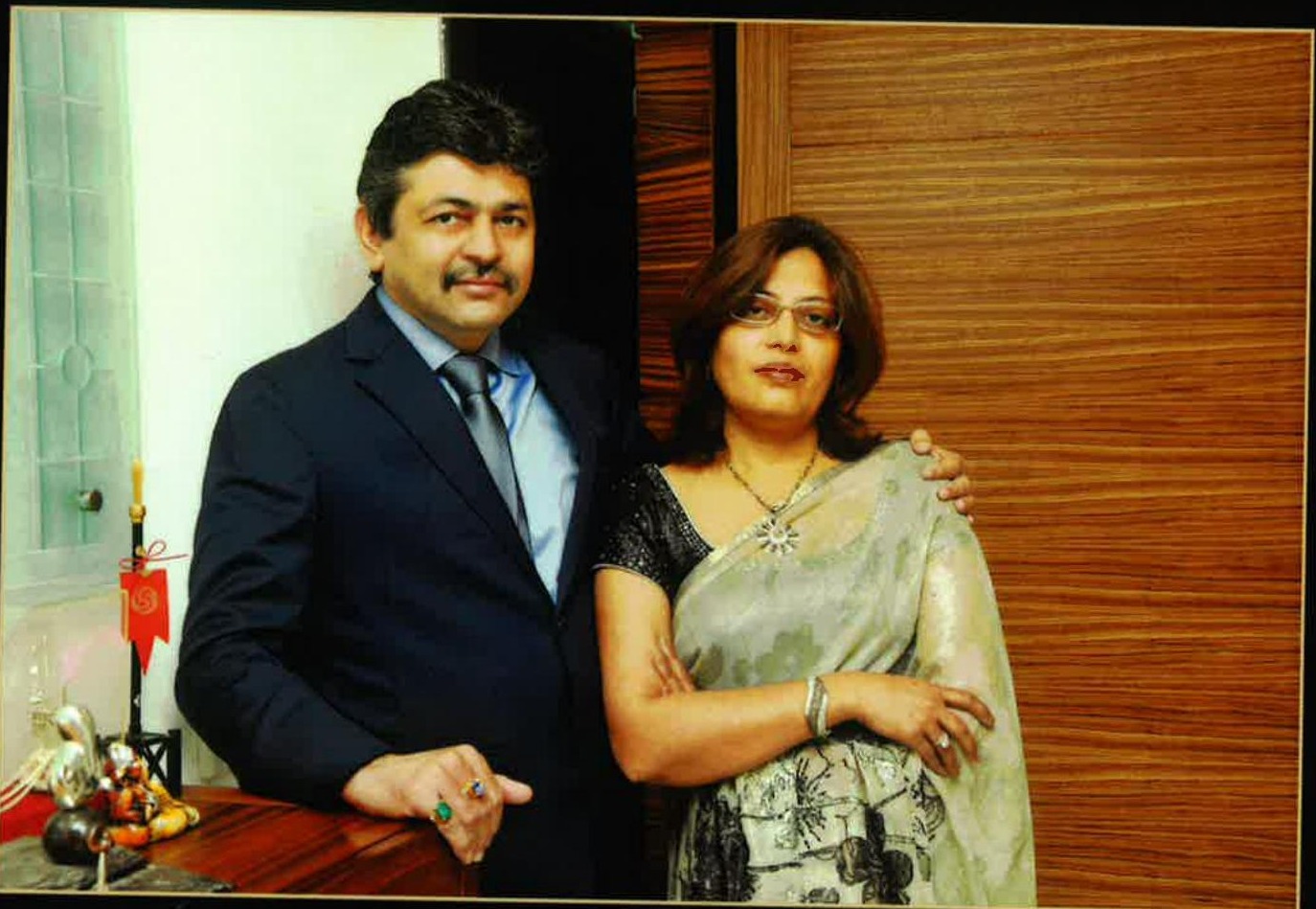
Being a very humble man, Rejesh attributed his ability of turning vision into reality to his sanskars and spirituality, which, he says, make him an achiever in all the fields, including commercial activities. "It is your belief in God: if you are pure, sincere in your effort — everything is possible. I am 46 years old, and the manner in which events have taken place in my life is almost magical… I will be thinking of doing something, and in a particular way, and lo and behold, it is done. The thing is that I am a good judge of people, and I can foresee their behaviour and assess their energy levels. This ability has come from my experiences during travels to Japan and Korea, and from participating in spiritual seminars. I related to the incident of the Nigerian lady, just as I was bothered by thoughts like ‘this lady is going to be a headache for me’ due to her greed and her attitude — the next day her resignation was on my table. At times, I have to postpone my travelling due to unavoidable reasons, but invariably the concerned person would call to say that he was sorry for not being able to make it to the meeting… I really feel blessed."
On Spiritual Matters
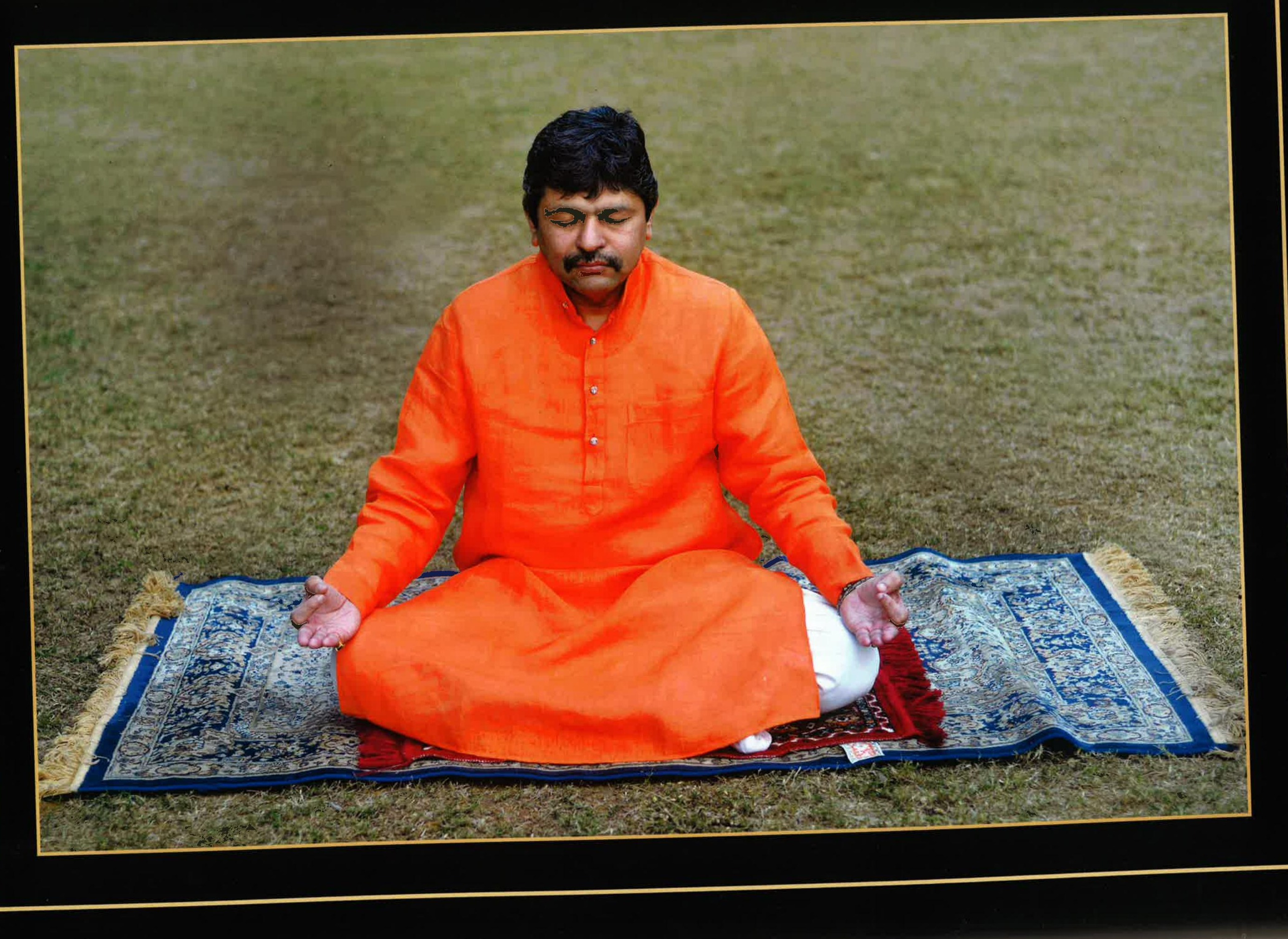
"Meditation is a vital part of my life and daily routine. I have to meditate for two to three hours every day. During flights I do not read books and magazines, rather I utilise the time to meditate." He very enthusiastically spoke at length about the concept of "Aura." "Each child is born a pure soul, but then the aura or the spiritual energy level are affected up to 33% by the karmas we bring with us. The other 33% is affected by our acquaintances and family, like wife, brother, friends, and staff. These energy levels or aura can be measured by instruments — a lot of scientific study has been done in Japan and Korea on this subject. Like the earth's faults, a certain geopathic stress too runs like lines over the earth. Despite meditation, despite being a saint, if you are on the geopathic stress line while making a decision, it will be negative; this applies to even the purest saints — their auras will be small at that point, making them take the wrong path."
"Their karmas, their associations, their stress due to the geopathic fault line — every person prevent them from thinking right. Every person is good — it is the circumstance that makes the person change. To keep your aura vibrant you must keep the company of good people. If you are a God-fearing person and you spend time with negative and low-thinking people, one day you too will begin to think and react like them."
“Leadership is putting others in the front.”— Nelson Mandela, quoted by Rejesh Satiija
On Reiki
Rejesh Satiija is the Founder Trustee of the Reiki Healing Foundation Trust, the world's largest group working towards an awakening for personal and global transformation, while promoting it as an alternate source of healing and brotherhood. "Reiki is basically Energy to heal. In Japan the average life expectancy is 95 years. Even though the Japanese drink and smoke quite a bit, yet even at 75 and above they are active, carrying on with their business and activities," he says.
"In India, after 75, mentally we are old and one does not meet persons in the 75 to 95 years bracket who are as active as the Japanese. Yet with the high standards of spirituality that we have attained, the average minimum age should be at least a hundred years. We are not using the universal energy to heal ourselves. Reiki originates from India — Sai Baba was healing through Reiki — in ancient times Buddhist travellers took with them the science of Reiki, and after being systemised by the Japanese teachers who named it Reiki, it has been sent back to us."
"In ancient wars, a puja was conducted for the king before the soldiers set off — this too was a form of Reiki. Water is an essential part of puja, kept in a kalash; water is the medium for transfer of energy… even for a ‘shaap’ (curse), a small quantity of water was held in the hand while pronouncing the ‘curse.’ For many holy and celebratory occasions, water is essential in the church; water is a part of the baptism ritual. Likewise the water from Zam Zam in Makkah – Madina is revered by the Muslims. In all religions there are energy levels which can be used not only to heal but to better the world, for better business and for the good of humankind. Reiki can be used to cure corruption — one can even try to cleanse the politicians," he argues.
"Rejesh maintains that Reiki is scientific, and that he has all kinds of instruments to measure energy levels, much like CT scans. He also relies on his intuition to gauge the positive or negative energy levels before he gets involved in any business activity with other parties. That is the secret of his success."
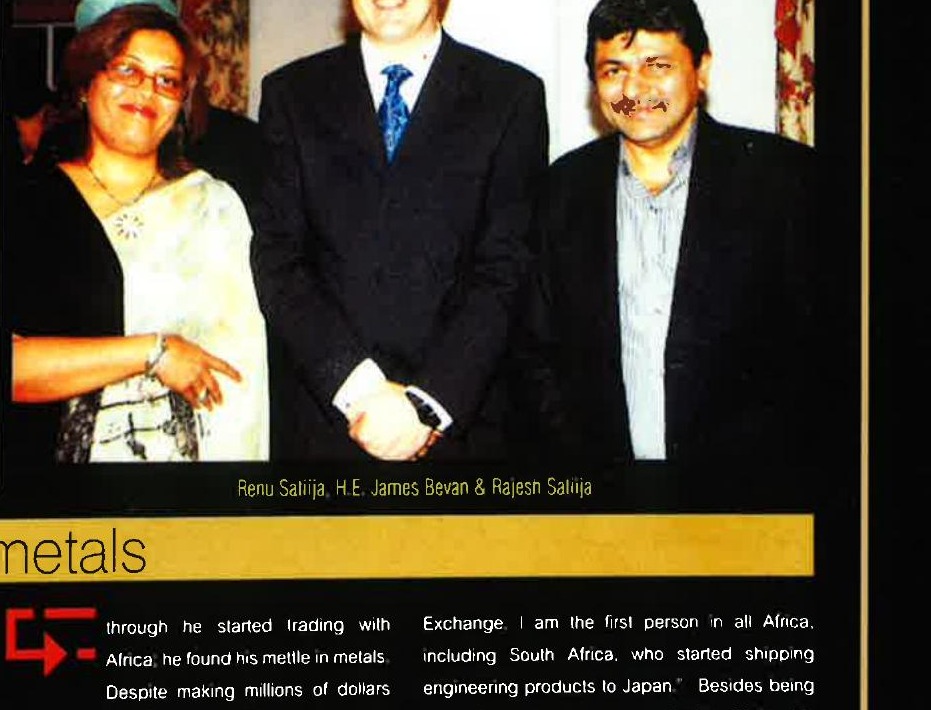
On a Mettle for Metals
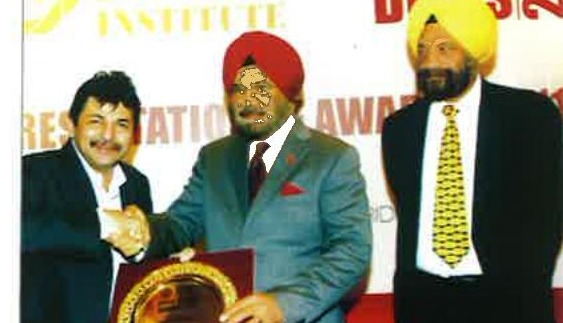
Through he started trading with Africa, he found his mettle in metals. Despite making millions of dollars with profitable trading, once Rejesh had Toyota's contract, he had gone into metal ingots by then. He scaled down trading to a full stop, since Toyota offered him an identity. Import Export was a generic activity. So in 2004 he stopped all trading and concentrated on metals. By then he had gone into production of alloy ingots and metals other than aluminium. His decision brought fantastic results. "My company is a name to reckon with in Japan, and is the only one from India and from the whole of Africa to be listed on the London Metal Exchange. I am the first person in all Africa, including South Africa, who started shipping engineering products to Japan." Besides being an engineer, he had luck on his side. During his trading days, not a single transaction incurred losses.
"At one time the metal prices crashed after he had sold ten containers full to a party who declined his loss, but by the time the containers reached, the metal prices were up temporarily only to come down again after the party had sold the ingots, making a nice slice of profit on the deal. More incidents of this nature gave him a new nickname: ‘Lucky.’"
On Education
Rejesh Satiija is in the process of acquiring land for a polytechnic institute in Bhiwadi. A recent brainwave has been to add on a school. "Between the ages of eight and twelve, children are at their most receptive, and when guided can be very nimble with calculations, even mathematical calculations. They can be fine-tuned in their aptitude. For a fair and crime-free society, we have to make a greater effort with the children."
"You can't change a tree — you can only chop down a rotten one — but you can ensure a healthier tree in the future by planting healthy seeds and providing proper care. In this manner, my contribution to society will be through the school in 20 to 25 years' time, when the children take their place in society as right-thinking adults." "We employ about 6,000 persons in the plant, and it is not at all easy to run an industry or a business there, so in order to divert those involved in petty thefts for survival, we created teams of Area Boys. These are young boys who have no work and generally join in riots on the roads, besides indulging in petty crime, just to get some money to feed themselves. We gave them the proposal of going around their area collecting scrap and then bringing the scrap to us. Today, some of the Area Boys have a car, a house, married and settled — they are applying their minds to make a better life for themselves. Some are on their way to becoming businessmen in their own right."
“You must be the change you want to see in the world.”— Mahatma Gandhi, quoted by Rejesh Satiija
On Management
"Till about four years ago, I was quite hands-on concerning the management of the various plants and factories. That was because in the start-up phase you have to be involved to keep up with developments. So I used to spend time on the shop floors of the factories, decisions in consultation with the managers etc., then we started growing, and at a hectic pace, so I set protocols for the management. You cannot grow without delegating responsibilities to the management and having systems in place. Having done so, the protocol must be followed, otherwise one only ends up creating complications for the managers. There are reporting and check systems in place when required — I would normally speak to the MD, financial head, and maybe some of the very senior heads. I do not get involved in the day-to-day management of my concerns."
"For example, if I require any information from the Nigeria plant, I shall probably speak to the MD. I am aware there are four phases in a person's life — as a child you are guided by your parents, then it is your youth, followed by the family phase, and its responsibilities. In the fourth phase your eyes are open, and your decisions are based on experience. My fourth phase is very interesting and exciting; I have a lot to accomplish — in business, in society, for my workers, for my family, along with branching out into real estate in India."
On Family
"Like all parents, I love my son and daughter immensely. So when it is family time, I let them choose the activity. A few days ago, my wife and children wanted to go to the theatre to see a movie — so a movie it was; once inside the theatre I switched off my phone so that all my attention was on enjoying the movie with them."
"At times my kids will decide that I should cook them breakfast, so breakfast it is — I do the chopping, cooking and then serve them breakfast. Sometimes they demand I make them dinner: I am very happy to go into the kitchen and delight my children with a dinner turned out without domestic help. I am a good cook too."
"When it is family time, I must spend that time the way they want — if they wish to see a film, or play chess, it is not much use me saying instead we go for a walk. The children decide how my time for them is to be spent. Me and my wife have brought up our children to be grounded. Despite the fact that they are aware they are well off, we have tried to instil a sense of social responsibility in them. Though they are young and in school, we avoid indulging them in terms of excessive expenditure. Prayers and meditation form an essential part of their daily routine."
Rejesh's parents' story reads like a fantastic voyage, much like a ship sailing into unknown waters. "Ancient seafarers had the pole star to guide them… so what kept him on course? Faith in God, self-confidence, focus, balance and a firm belief that, much like night follows day, everything will work out in the end. Everything in life should be balanced — personal, business, social and family time. Much like a well-planned meal that takes into account vitamins and other nutrients for ensuring good health, concentrating on one of the nutrients will not allow the body to function at its best; similarly one must make time for family, work and socializing, yet when you are giving time, give quality time."
"Having lived his life well, and on his terms, what would he advise a fresh-out-of-college youngster ready to take on the world? He puts his fingertips together, reflects, and says: ‘Never take short cuts. Be patient, give your best, and do whatever you have to do, do not take the easy route. If you are patient, you will have a beautiful journey through life ahead.’”